A Bowl of Quiet Defiance: Celeriac Remoulade for Dark Afternoons
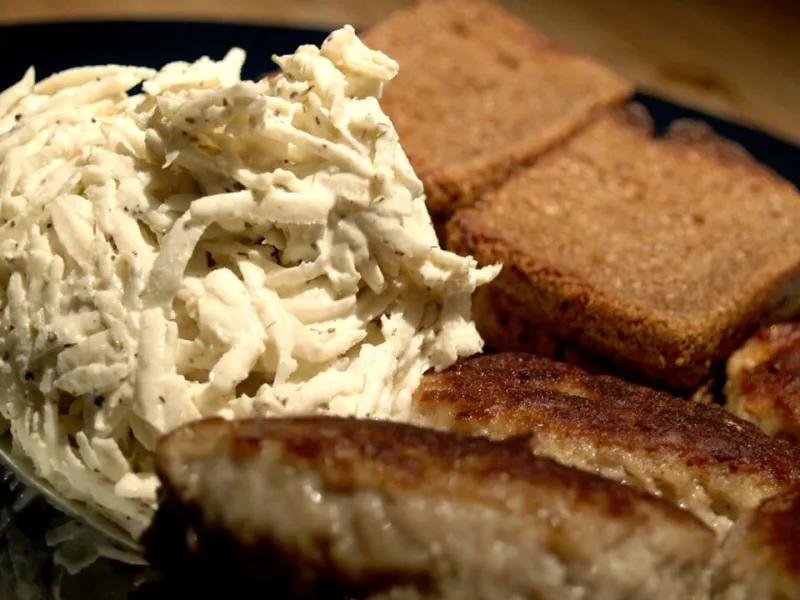
Photo: cyclonebill, CC BY-SA 2.0, via Wikimedia Commons
November has a smell. It is wet leaves, bus brakes and the faint ghost of a bonfire. It is also the month when the nation's salad drawers begin their annual slide into shame: a flaccid cucumber, half a pepper, a bag of leaves turning to green slime. This is not a moral failing. It is a design fault. Lettuce is a summer temperament trapped in a winter fridge.
Celeriac remoulade is the answer, and it is not a polite answer. It is a bowl of pale matchsticks with mustard in its blood. It turns up in November, when the root vegetables look like they have been dug up from a bog, and it says: yes, and? It does not apologise. It does not pretend to be a salad for people who are being good. It is a salad for people who are about to eat a large piece of ham and would like something sharp alongside it.
First, the root
Celeriac is the ugly one at the back of the greengrocer's, wrapped in plastic like a suspicious parcel. It looks like a mud-covered brain that has seen things. Buy one that feels heavy for its size and is firm all over, with no soft patches and no smell of old celery. A medium one, about 600g before peeling, will serve four to six as a side, or two as a greedy starter with bread and ham.
Peel it brutally. There is no delicate way to do this. Slice off the knobbly exterior until you reach the pale, dense flesh, then cut it into matchsticks. A food processor with a coarse grater blade is the sensible route. A julienne peeler works if you are patient. A box grater will do in a pinch, but go coarse and stop before the celeriac turns to pulp. You want texture, not baby food.
Toss the matchsticks immediately with the juice of a lemon and a good pinch of salt. This stops the celeriac going an unappealing shade of beige and starts the softening process. Leave it for ten minutes, then tip it into a colander and press gently, not brutally, to lose the water it has wept. Nobody wants a watery remoulade. That is how salads get a bad name.
The formula
This is the classic mustard-mayonnaise formula, and it is not a place for improvisation until you have made it once properly.
- 1 medium celeriac, about 600g, peeled and cut into matchsticks
- Juice of 1 lemon
- 1 tbsp Dijon mustard, not English, not honey mustard, not whatever is lurking at the back of the door
- 4 to 5 tbsp good mayonnaise
- 1 tsp white wine vinegar, or a little extra lemon juice
- Salt and black pepper
- Optional: a tablespoon of capers, a few chopped cornichons, or a handful of chives
Whisk the mayonnaise, Dijon, vinegar and a generous grind of pepper in a large bowl. Fold in the drained celeriac. Taste it. It should be sharp, mustardy and just on the right side of aggressive. Add more mustard if it tastes limp, more lemon if it tastes heavy, more salt if it tastes like nothing. Cover and put it in the fridge.
The hour in the fridge is not laziness
This is the bit people skip, and it is the bit that makes the dish. After an hour, the celeriac loses its raw, chalky edge and becomes tender-crisp. The mustard mellows from a slap into a hum. The mayonnaise loosens slightly, the lemon settles in, and the whole thing starts tasting like one thing rather than three ingredients in a bowl. Three hours is better. Overnight is fine, though the texture will be softer and the colour slightly less perky. Add herbs just before serving, not before the fridge, unless you enjoy looking at black flecks.
If it comes out of the fridge too thick, loosen it with a teaspoon of water or lemon juice. If it has turned watery, tip it into a sieve for a minute and stir it back together. This is cooking, not surgery.
Where it belongs
As a starter, put it in a plain bowl with cornichons, good bread and a few slices of ham. That is a complete November lunch, and it takes less time than waiting for a delivery.
As a side, it cuts through roast chicken, sausages, steak, cassoulet, tartiflette, or any of the rich, slow, dark things we cook when the light goes at half past four. It is especially good with Christmas ham, should you be the sort of person who plans that far ahead. It also sits happily next to a baked potato, or under a piece of fried fish, or alongside an omelette that has been folded with more confidence than skill.
And then there is the ham sandwich. Butter a piece of baguette or sturdy granary bread. Add thick-cut ham, a spoonful of remoulade, maybe a slice of Comte if you are feeling grand. Press it together. Eat it standing up in the kitchen while looking out at the rain. This is one of the great British-French collaborations, and nobody needs to write a treaty about it.
The argument
November deserves better than a sad leaf. Celeriac remoulade is cheap, make-ahead, and quietly belligerent. It does not need to be warm, it does not need to be dressed at the last minute, and it does not care whether you have matching bowls. It is a salad that behaves like a condiment and a side dish and a sandwich filling, depending on what you need from it. Anyone who says salad is summer food has not met a root vegetable with a bit of mustard. Make a bowl on Friday. Eat it on Saturday. Thank yourself on Sunday.