Four Cheeses, No Committee: An Apero Board for the Terminally Overwhelmed
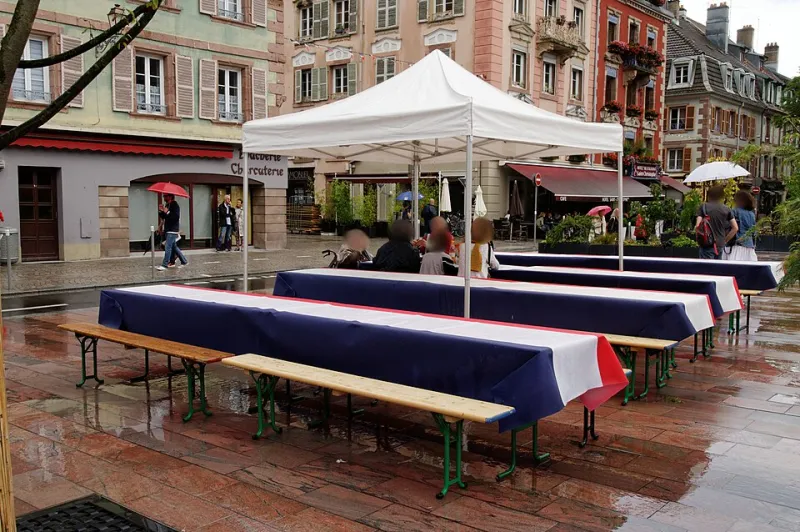
Photo: Peachyeung316, CC BY-SA 4.0, via Wikimedia Commons
There is a moment, roughly forty minutes before guests arrive, when a certain kind of host stands in front of an open fridge and begins to apologise to the cheese. Out loud. For being insufficient. This is a real phenomenon and it must be stopped.
No one has ever left a good party thinking 'the cheese selection was a touch narrow'. They have left thinking 'I wonder if there's more of that soft one'. That is the entire standard you are being asked to meet.
Rule One: Four Is a Number, and It Is the Right Number
One is a snack. Two looks like you ran out. Three is fine but looks accidental. Four reads as deliberate, gives people a choice, and — crucially — fits on one board so you are not balancing plates on the arm of a sofa.
Beyond four, you are not adding pleasure. You are adding knives, and questions, and something that will be left out overnight and smell like regret on Sunday.
So: four. Here is the formula.
The Formula
- The Anchor. A firm, cooked, nutty number. Comté if the budget allows, a decent Gruyère if not, a mature Cantal if you want to feel clever. This is the cheese people will eat the most of, so buy more of it than feels reasonable. Roughly double what you think.
- The Collapse. Something soft and runny and a bit undignified. A whole Camembert or a Brie de Meaux, ideally at room temperature and ideally leaking slightly. If you're feeling flush in November, a Vacherin Mont d'Or — in season now — is the move, and it will be the only thing anyone talks about.
- The Blue. Fourme d'Ambert for something creamy and gentle, Roquefort for something that argues back. Supermarket own-brand versions are fine; buy from the counter if there is one.
- The Wildcard. A soft goat log, or a washed-rind number if your guests are the sort who enjoy being challenged. Sainte-Maure de Touraine, or a plain little Chabichou, or — quietly subversive — a very good mature Cheddar, which is French in spirit if not in paperwork.
Waitrose, M&S and the better Sainsbury's counters will do all of this. If you have a proper market near you — Borough, St Nick's in Bristol, Kirkgate in Leeds, the Grainger in Newcastle — go to the cheese stall, point, and ask for a small piece of four things. Cheesemongers do not judge. They are simply pleased to see you.
Stop Apologising, Start Deciding
Every 'oh, it's nothing, I just threw it together' is a small act of self-sabotage. You did not throw it together. You chose it. Stand behind the cheese.
And while we are here: do not pre-slice everything. A board of neat little pre-cut wedges looks like a hotel breakfast and tastes like one too — cheese dries out within twenty minutes of being cut. Put out big lumps and pieces, one knife per cheese if you are feeling institutional, one knife if you are feeling French. People are perfectly capable of cutting their own.
What Goes Alongside
Keep it to things that do a job.
- Cornichons. Sharp, crunchy, cuts through the fat. Non-negotiable.
- Walnuts and a few soft dried figs or prunes. Two small piles, not a decorative spiral.
- Honey. A small pot, a spoon, no drama.
- Radishes, butter, sea salt. Absurdly good with a runny cheese and takes ninety seconds.
- Bread. A baguette, sliced, and a handful of plain crackers in a bowl off to the side — not on the board, where they will go soft under the Brie.
No grapes. Well — grapes if you like grapes. But nobody has ever needed grapes.
The Drinking
Dry Breton cider is the great underrated cheese drink and costs less than the Comté. A kir, made properly with a decent crème de cassis and cold aligoté or Bourgogne, is exactly the right aperitif and takes four seconds. Champagne, obviously, if it is that sort of evening. Cold beer works with everything and we will not be taking questions.
The Method That Lets You Sit Down
Assemble the whole thing before anyone arrives. Board out, cheeses at room temperature for at least an hour beforehand — cold cheese is a crime against the French and against your own evening — knives out, cornichons drained, glasses on the side. Open the first bottle early and put it somewhere visible.
Then, when the doorbell goes, you have nothing to do but answer it. No last-minute plating. No handing round. The board sits in the middle of the table and people help themselves, which they will, repeatedly, for the next two hours, while you sit down and have a drink like a person who has their life together.
Nothing on the board is an apology. Everything on it is a decision. That is the whole strategy.
One Last Thing
Buy more of the anchor cheese than you need. There is no scenario in which you regret it, and there is a very specific scenario — 11pm, kitchen, one remaining bottle, everyone else gone home — in which you are extremely glad of it.